

Every week my feed hands me a new verdict on vibe coding. Vibe coding is the future. Vibe coding is garbage, you still have to verify everything. It is only good for grunt work. Honestly, manual is faster. One verdict for the whole technique, case closed.
My hunch was that the debate is broken because it treats vibe coding as one thing, and it is not one thing. Whether it works depends on what you are building, and above all on what it costs to validate the result. I carry four scenarios in my head, and they get four different verdicts.
But I just wrote a post arguing that any claim about the world should carry a receipt. “Everyone on LinkedIn is doing blanket verdicts” is a claim about the world. So before publishing it, I went and counted.
I counted 51 takes, and my hunch was half wrong
I collected every vibe coding take I could actually read and classify, 28 search-indexed LinkedIn posts and 23 blog essays and press pieces. For each one I asked one question. Does it issue a single verdict for all of vibe coding, or does it say it depends on the scenario?
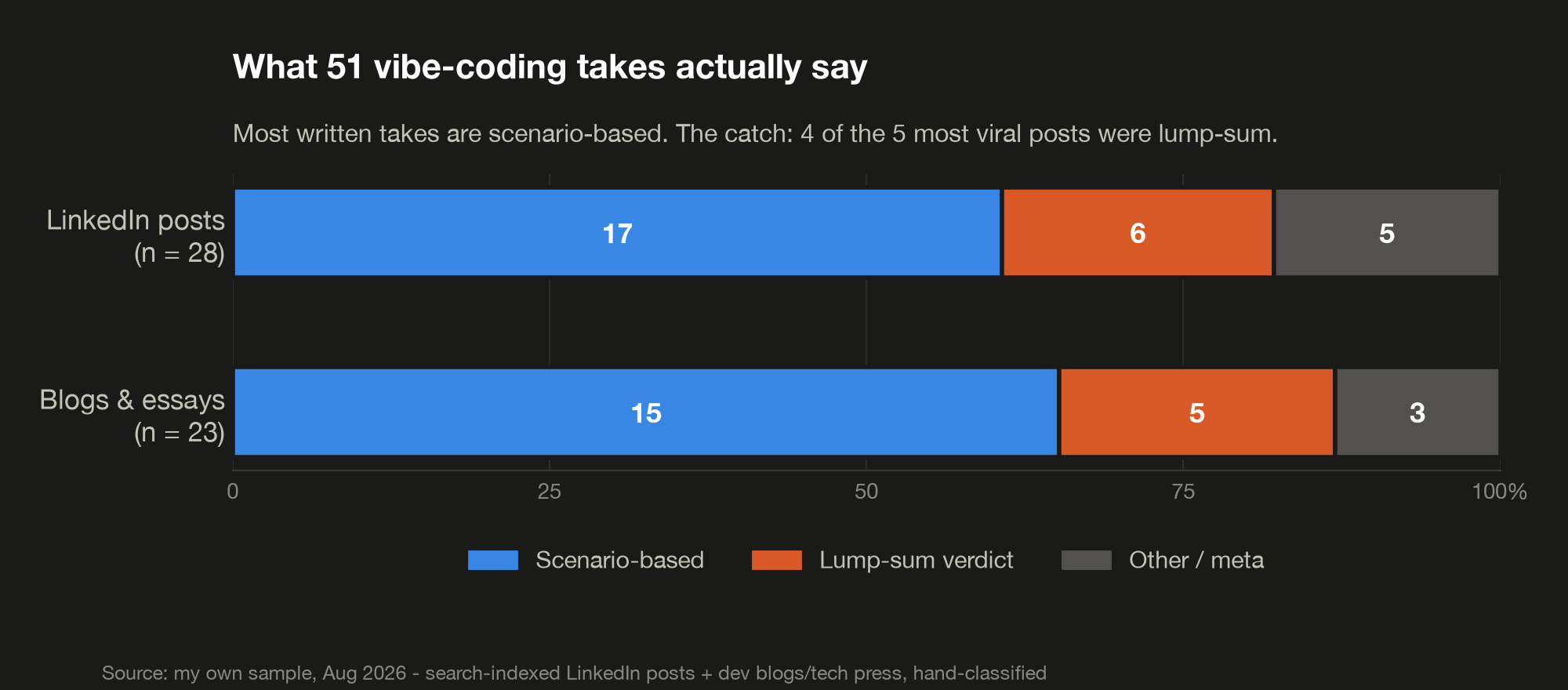
About 63 percent of what I could read was scenario-based. So the strong version of my hunch, that nobody breaks it down, is simply false. I am glad I checked before writing it.
The count surfaced something better though. Look at where the blanket verdicts live. The most viral posts in my sample were almost all lump-sum. “Welcome to the Age of Vibe Coding” sits at 1,271 reactions. “Adapt or become obsolete” pulled 309 comments. “Vibe coding is eating SaaS” got 257 reactions. Four of the five highest-engagement posts I found gave one verdict for everything, and the nuance was underneath them, in the comment sections, where people quietly did the segmentation the author skipped. Fine for internal tools, not for core systems, that kind of thing.
There is also a pattern I started calling the headline lie. A lump-sum title, “Vibe Coding: A Waste of Time and Money,” sitting on top of a body that is actually scenario-based. Judged by headline alone, which is how a feed gets read, several items flip categories.
So the honest finding is this. The discourse is not ignorant, it is flattened. The scenario thinking exists, but the algorithm pays for verdicts, so verdicts are what you scroll past. Even Andrej Karpathy, who coined the term in February 2025, scoped it in the same breath, “not too bad for throwaway weekend projects.” The lump-sum framing is what the feed did to a scoped idea.
Developers already vote with their hands
Here is the part I find genuinely funny. While the feed argues yes or no, actual developer behavior is a gradient, and it is exactly the gradient you would expect if everyone privately agreed that scenario is what matters.
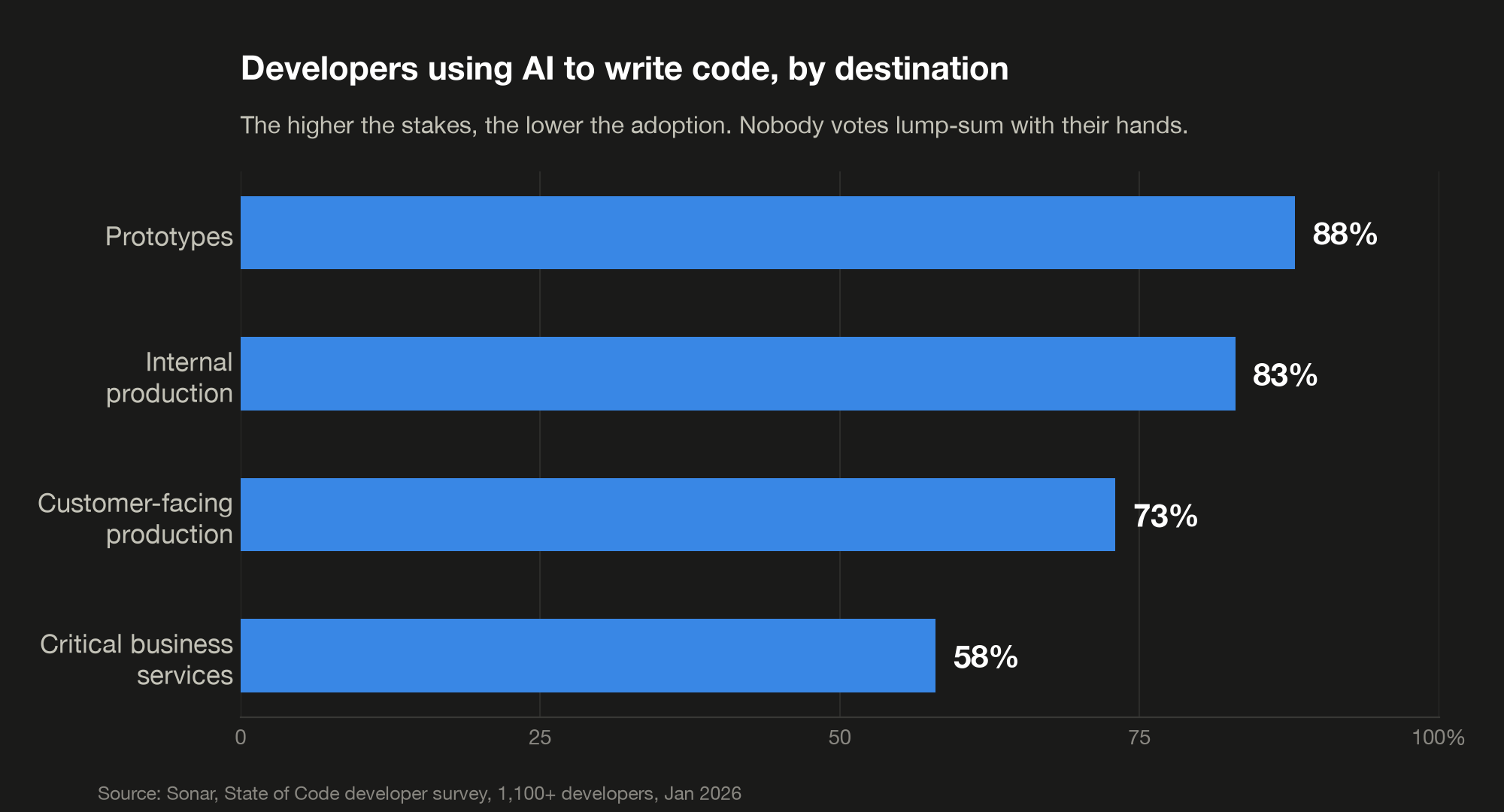
Adoption falls step by step as the stakes rise. Nobody in that survey is acting out “vibe coding is the future” or “vibe coding is garbage.” They are acting out “it depends,” including, I would bet, some of the people posting verdicts.
The Stack Overflow survey shows the same split inside individual heads:
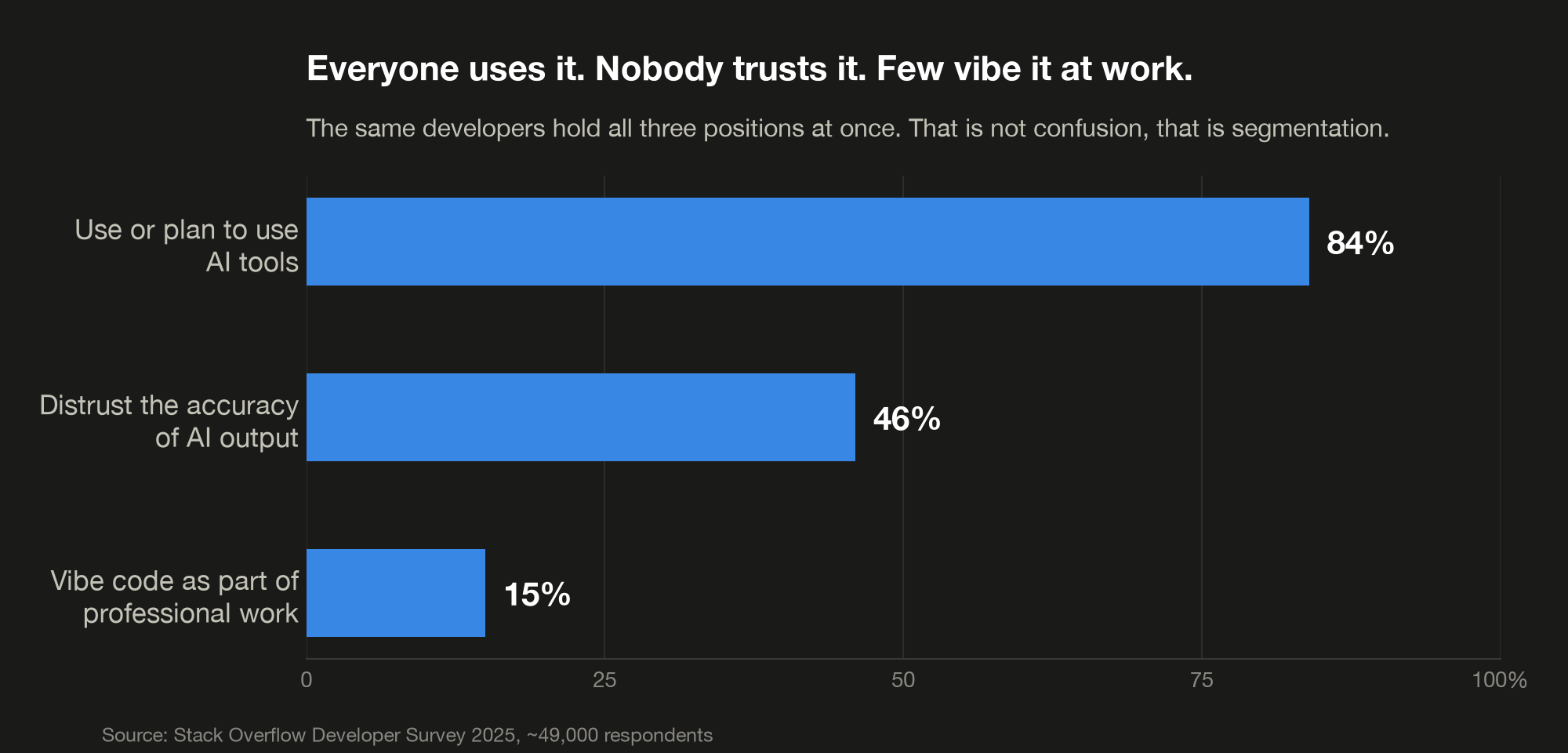
84 percent use the tools. 46 percent distrust the output. Only 15 percent vibe code professionally. Those three numbers only fit together if developers are segmenting. Use it here, verify it there, refuse it over there.
My four scenarios
This is the breakdown I actually use. The axis underneath it never changes: what does validation cost, and who pays if I skip it?
1. A small fix in an existing codebase
A defect, a security patch, a button that stopped working. Vibe coding is viable today. You give the AI the intent and the context, and the diff is small enough that reviewing it is cheap. Validation costs minutes. This is where the “you still have to verify everything” objection is weakest, because verifying everything is a two-minute read.
2. A decent-sized new feature
Still earns its keep, but differently. It is best at getting you unstuck. Where to start, where things go, iterating toward the shape. The catch is that the benefit does not scale with the output. The more code it generates, the more you have to read and mentally connect, and validation cost grows faster than typing time ever did.
3. A full production feature or application
This is where it breaks, and not because the generation fails. The generation succeeds all too well. It breaks because validating everything, correctness and security both, stops being practical. Fastly surveyed 791 developers and found nearly a third spend so long fixing AI code that it offsets most of the time saved. Veracode ran benchmark tasks against more than a hundred models and got security vulnerabilities in 45 percent of them, and newer models were not better. Generation is cheap now. Validation is the bottleneck, and in production the bill for skipping it goes to your users.
4. Local, personal, non-public software
Full-app vibe coding works here, today, and I do not say that hypothetically. I have vibe coded a project dashboard, a budget tracker, and a token usage dashboard. All of them run locally, and all of them got validated the honest way personal tools get validated: I use them every day, and they either work or I fix them. Nothing is exposed and nobody’s data is at risk. This is the scenario the lump-sum skeptics erase entirely.
A teaser while I am here: demos of these apps are coming to SleemAI soon.
Notice the two axes doing the work. The size of the change sets the validation cost. The exposure of the result sets the price of a miss. Every published framework I found in the research runs on one axis only. Stakes only, or code size only, or whether anyone will ever maintain it. All useful, all half the picture. You need both, because a tiny change to an exposed system and a huge change to a private one are both fine, and the debate keeps mistaking one for the other.
One honest caveat against my own scenario 1. A controlled study by METR found experienced developers were 19 percent slower with AI on small tasks in code they knew deeply, while believing they were faster. So viable does not always mean faster. My claim for small fixes is that validation is cheap, not that you will beat an expert who already knows the file.
Ask the better question
I am not going to hand you a verdict on vibe coding, because a verdict is the wrong shape for the answer. The question is not whether vibe coding works. The question is what validation costs here, and who pays if I skip it. Cheap validation and a small blast radius, go ahead. Expensive validation and a public blast radius, that is not caution talking, that is arithmetic.
The feed will keep serving verdicts, because verdicts travel and nuance sits in the comments. Next time a post tells you vibe coding is the future or a scam, check which of the four rooms the author is standing in. They are usually describing one room, loudly, as if it were the whole house.
Sources for the numbers: my own 51-item classification (August 2026, search-indexed posts only, so the real feed likely skews even more lump-sum than my tally); Sonar, State of Code developer survey, 1,100+ developers, January 2026; Stack Overflow Developer Survey 2025, about 49,000 respondents; Fastly developer survey, 791 developers, 2025; Veracode GenAI Code Security Report, 2025; METR, July 2025; and Karpathy’s original tweet, February 2025.